
Barcode Labels and Ribbons: A Complete Guide to Types, Sizes, Materials, and Applications
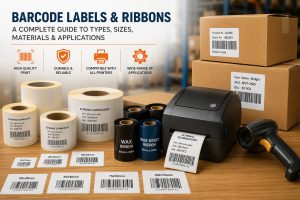
Barcode labels are an essential part of modern business operations. From retail stores and supermarkets to warehouses, hospitals, manufacturing units, and logistics companies, barcode labels help businesses identify products, manage inventory, and improve operational efficiency. When paired with the right barcode ribbon, they produce high-quality, durable prints that can withstand daily handling and various environmental conditions.
If you’re planning to purchase barcode labels or ribbons, understanding the different types, sizes, and materials can help you choose the right solution for your business.
What Are Barcode Labels?
A barcode label is an adhesive sticker that stores machine-readable information in the form of a barcode or QR code. In addition, it can display important product details such as the product name, SKU, price, manufacturing date, expiry date, batch number, serial number, and company logo. As a result, businesses can quickly identify products, improve inventory management, and reduce manual errors during billing and stock tracking.
Barcode labels help businesses identify and scan products quickly and accurately. As a result, they reduce manual errors and improve inventory accuracy. Additionally, barcode labels work seamlessly with barcode printers and scanners to simplify billing, stock management, product tracking, and warehouse operations, making daily business processes faster and more efficient.
What Is a Barcode Ribbon?
A barcode ribbon is a roll of ink used in thermal transfer barcode printers. During printing, heat from the printhead transfers ink from the ribbon onto the barcode label, creating a sharp and long-lasting print.
Unlike direct thermal printing, thermal transfer printing provides greater durability and resistance to fading, scratches, moisture, and chemicals. Choosing the correct ribbon is just as important as selecting the right label.
Types of Barcode Labels
Paper Barcode Labels
Paper barcode labels are the most commonly used and cost-effective option for everyday labeling needs. They are ideal for retail stores, supermarkets, pharmacies, and general inventory management because they provide clear, high-quality prints. However, paper labels are best suited for indoor use, as they are not resistant to water, moisture, or harsh chemicals.
Direct Thermal Labels
Direct thermal labels do not require a barcode ribbon, making them a simple and cost-effective printing solution. Instead, the print appears when heat is applied directly to the label’s surface. Therefore, they are ideal for short-term applications such as receipts, courier labels, shipping labels, and temporary product identification. However, because the print can fade over time when exposed to heat, sunlight, or friction, they are not recommended for long-term use.
Thermal Transfer Labels
Thermal transfer labels require a barcode ribbon to produce clear and durable prints. As a result, they offer excellent resistance to fading, scratches, and daily wear. Therefore, these labels are ideal for inventory management, warehouse operations, manufacturing, asset tracking, and long-term product identification where print quality and durability are essential.
Synthetic Labels
Synthetic barcode labels are made from durable materials such as polypropylene or polyester. As a result, they are highly resistant to water, oil, chemicals, moisture, and tearing. Therefore, they are an excellent choice for laboratories, manufacturing units, warehouses, outdoor environments, and other industrial applications where long-lasting, reliable labels are required.
Tamper-Evident Labels
Tamper-evident labels are specially designed to leave visible evidence when someone tries to remove or peel them off. As a result, they help prevent unauthorized access and product tampering. Therefore, these labels are widely used for warranty seals, electronic devices, pharmaceutical products, and security applications where product authenticity and protection are important.
Types of Barcode Ribbons
Wax Ribbon
Wax ribbons are economical and commonly used with paper barcode labels. In addition, they are ideal for retail stores, supermarkets, and general office applications. As a result, businesses can produce clear, high-quality barcode labels at a lower printing cost.
Wax-Resin Ribbon
Wax-resin ribbons provide better resistance to scratches, smudging, and light moisture. They are suitable for healthcare, logistics, and warehouse environments.
Resin Ribbon
Resin ribbons produce the most durable prints and are recommended for synthetic labels. They offer excellent resistance to heat, chemicals, moisture, and abrasion, making them ideal for industrial and outdoor applications.
Standard Barcode Label Sizes
Choosing the correct label size depends on the product size, barcode content, and printer compatibility.
| Label Size | Common Applications |
|---|---|
| 25 × 15 mm | Jewellery, cosmetics, small accessories |
| 30 × 20 mm | Medicines, cosmetics, stationery |
| 38 × 25 mm | Hardware stores, retail products, electrical items |
| 50 × 25 mm | Grocery products, inventory labels |
| 50 × 38 mm | Warehouse stock labels, pharmacy products |
| 60 × 40 mm | Carton labels, manufacturing |
| 75 × 50 mm | Packaging and logistics |
| 100 × 50 mm | Warehouse and inventory identification |
| 100 × 150 mm | Courier and shipping labels |
Among these, 38 × 25 mm is one of the most popular barcode label sizes for retail stores and hardware shops because it provides enough space for a barcode, product name, and price while fitting small products.
Standard Barcode Ribbon Sizes
Barcode ribbons should always be slightly wider than the barcode label.
Common ribbon sizes include:
- 40 mm × 300 m
- 60 mm × 300 m
- 80 mm × 300 m
- 110 mm × 300 m
Selecting the correct ribbon width ensures complete print coverage and protects the printer’s printhead.
How to Choose the Right Barcode Label
Before purchasing barcode labels, consider:
- Your barcode printer type
- Label dimensions
- Product size
- Indoor or outdoor use
- Paper or synthetic material
- Print durability requirements
- Ribbon compatibility
- Environmental conditions
Using the correct combination of label and ribbon ensures high-quality printing and reliable barcode scanning.
Benefits of Barcode Labels
Using barcode labels offers several advantages:
- Faster product identification
- Accurate inventory management
- Reduced manual errors
- Quick billing and checkout
- Better warehouse organization
- Improved stock tracking
- Enhanced customer service
- Time and cost savings
Industries That Use Barcode Labels
Barcode labels are widely used in:
- Retail Stores
- Supermarkets
- Hardware Shops
- Pharmacies
- Hospitals
- Manufacturing Industries
- Warehouses
- Logistics Companies
- Courier Services
- Textile Businesses
- Jewellery Shops
- Libraries
- Educational Institutions
Why Choose Extremaa Technologies?
Extremaa Technologies offers complete barcode solutions, including barcode printers, barcode scanners, barcode labels, barcode ribbons, and inventory management software. We help businesses select the right label size and ribbon type based on their industry and application.
Whether you need barcode labels for retail billing, warehouse inventory, manufacturing, or shipping, our experienced team provides reliable products, expert guidance, installation support, and after-sales service.
Frequently Asked Questions
Which barcode label size is most commonly used?
The 38 × 25 mm label is one of the most widely used sizes for retail stores, hardware shops, and supermarkets.
What is the difference between direct thermal and thermal transfer labels?
Direct thermal labels do not require a ribbon and are suitable for short-term use. Thermal transfer labels use a ribbon and produce more durable, long-lasting prints.
Which ribbon is best for paper labels?
Wax ribbons are the most economical and commonly used option for paper barcode labels.
Can barcode labels be waterproof?
Yes. Synthetic barcode labels printed with resin ribbons are waterproof, tear-resistant, and suitable for harsh environments.
Conclusion
Barcode labels and ribbons are essential for efficient inventory management, product identification, and accurate billing. Choosing the correct label size, material, and ribbon type improves print quality, extends label life, and ensures reliable barcode scanning.
If you’re looking for premium-quality barcode labels, ribbons, barcode printers, or complete barcode solutions in Kerala, Extremaa Technologies offers products and expert support to help your business improve productivity and streamline daily operations.
 Schedule A Demo
 Request a Call